


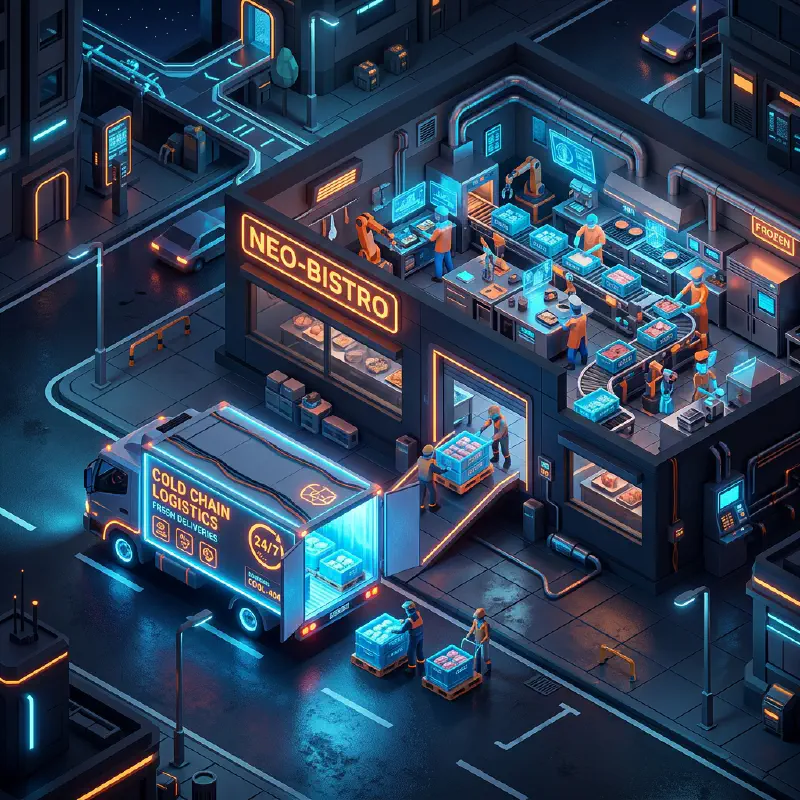
What are the Key Takeaways from this Executive Summary?
Quick answer
- Temperature is the product. A load that leaves its range can be rejected or written off, so the reading matters as much as the delivery.
- JIT delivery is a timing problem. Restaurants hold little stock, so they depend on frequent small deliveries, cross-docking and short dock turnaround.
- Compliance is a records problem. Food safety rules ask you to show an unbroken temperature and custody trail for each batch, which means the records have to be kept and readable.
Why Is Cold Chain Integrity the Backbone of Food Service Logistics?
Quick answer
For a Director of Cold Chain Operations, moving perishable goods from farm to fork leaves little room for error. One temperature excursion in transit or in storage can mean a rejected load, a regulatory finding, and a customer who stops trusting your deliveries. Ambient freight does not work this way. Cold chain work needs refrigerated trailers (reefers), climate-controlled distribution centers, and someone watching the readings.
Multi-temperature loads are harder again. One trailer may carry frozen, chilled and fresh goods in separate zones divided by insulated bulkheads. Outside temperatures move through the day and along the route, so the refrigeration unit has to hold each zone while the load on it changes. That depends on sound insulation and bulkheads, and on the reefer unit being serviced on schedule.
Trailer telematics and probe sensors report what the air and the product core are doing. When a reading drifts out of range, somebody has to see it in time to act: divert the load to the nearest cold store, or tell the driver what to check before the product crosses its threshold. Reading the history afterwards is the other half of the job. Pull twelve months of excursion events from your telematics feed and group them by lane, by carrier and by trailer number. The same lanes, carriers and units tend to recur, which tells you where maintenance, training or a different carrier would change the outcome. Your fill rate and your insurance claims file are where that shows up.
How Does Just-In-Time (JIT) Delivery Transform Restaurant Supply Chains?
Quick answer
Space in a restaurant is expensive, especially in dense urban markets. Few operators can give up floor area to walk-in freezers, coolers and staging. So they order often, in small quantities, from broadline distributors and specialty suppliers. The inventory and the sorting stay upstream.
Serving thousands of storefronts that way means the network has to be synchronized. Cross-docking is common: bulk inbound produce or dairy is sorted, consolidated and loaded onto outbound trucks with little or no time in storage. That works when the Warehouse Management System (WMS) and the Transportation Management System (TMS) are working from the same order and timestamp data, so inbound arrivals line up with outbound departures. A delay in that data, a dock door assigned to the wrong trailer, or a less-than-truckload (LTL) shipment staged late, and the restaurant is short an ingredient at service. For a supply chain VP the levers are dock turnaround time, dispatch timing and labor coverage at the hours freight actually moves. Our use cases describe how freight records are read and checked against the plan they were meant to follow.
What Are the Biggest Threats to Strict Shelf-Life Management?
Quick answer
Shelf life is a clock that starts at harvest or processing. Fresh produce, live seafood, dairy and raw meat begin to degrade immediately. Every hour in a trailer yard, at a congested dock or in a badly zoned warehouse comes off the life the customer gets. For a food and beverage supply chain manager, remaining shelf life on arrival is a metric in its own right. It decides what the kitchen can serve, how much the kitchen throws out, and how you score on their vendor scorecard at renewal.
Demand makes this harder. Restaurant foot traffic moves with weather, local events and the calendar, so a regional distribution center can be drawn down faster than planned or left holding stock that will not keep. Two things help. First, allocate by First-Expire, First-Out (FEFO), which picks by the actual expiry date, rather than First-In, First-Out (FIFO), which picks by arrival date and is not always the same thing. Second, cut yard dwell: a Yard Management System (YMS) that records gate-in, gate-out and dock assignment shows you where loaded reefers are standing and burning fuel to hold temperature. To see whether either change worked, take remaining shelf life at receipt and your shrinkage write-offs for one season, and compare them with the same season a year earlier.
How Can Operations Leaders Optimize Routing for Highly Perishable Goods?
Quick answer
Food service routing is harder than dry van distribution. A single restaurant route can have ten to fifteen stops in dense city traffic. Drivers deal with narrow alleys, restricted delivery zones, noise and idling rules, and receiving hours set by the kitchen rather than by you. When the product has days or hours of life left, a route fixed days in advance will not survive the day it is driven.
Planning has to weigh several constraints at once. Sequence is geographic for mileage, but it is also chronological: the most temperature-sensitive cargo and the earliest receiving windows set the order. A delay at the first drop cannot be allowed to cost you the frozen product on the last drop. Routing that re-sequences during the day, on current traffic, weather and reported receiving delays, keeps one late stop from spreading. It also cuts total miles, diesel burned, and the number and length of door openings that let warm air into the trailer. The figures to watch are miles per stop, fuel per route, and on-time in-full (OTIF) — the share of deliveries that arrive on time and complete — read over a quarter rather than a day.
What Role Does Regulatory Compliance Play in Cold Chain Operations?
Quick answer
Regulatory attention on food service supply chains keeps growing. FSMA in the United States, and similar standards in other markets, moved the emphasis from responding to foodborne illness to preventing it. For distributors and carriers that means keeping a trail of custody and conditions for every SKU that moves through the network, in a form an auditor can follow.
That is not only the compliance officer’s job. Electronic logging devices (ELDs), trailer telematics and warehouse temperature sensors have to carry timestamps that line up, or the temperature record cannot be tied to the load from origin (FOB, where the buyer takes title at the shipping point) to destination (CIF, or direct store delivery). When a recall or a contamination event happens, the question is how quickly you can name the affected batches and everywhere they went — backward to the supplier and forward to every store. That answer comes out of how your batch and lot records are kept, long before anyone asks for it. Written data governance and automated reporting are what make it available on the day.
Conclusion
Quick answer
Mastering the food service supply chain takes more than insulated trailers and fast deliveries. It takes knowing, per load rather than per month, what the temperature actually did in transit, how much shelf life was consumed on the way, and which delivery window was missed as a result. Those three facts are almost always recorded — by the reefer telemetry, by the receiving scan, by the route log — and almost never read against each other in time to matter.
That is the reading problem Runink FACE works on: comparing records held in separate systems against the rule that governs them, and raising what differs as a named load rather than a spoilage rate. The decision about what to do with a flagged load stays with your quality team. Get in touch if you want to walk the mechanism through against your own reefer and receiving data.
Sources
- FDA Food Safety Modernization Act (FSMA) — The regulatory framework and its requirements for preventive food safety and traceability
- SupplyChainBrain: The Future of Cold Chain Logistics — Analysis of the growing complexity and equipment requirements of temperature-controlled supply chains
- Inbound Logistics: Cold Chain Optimization — Practices for reducing temperature excursions and managing multi-stop refrigerated transport
- CSCMP State of Logistics Report — Annual benchmarking data on logistics performance, transportation costs and warehouse efficiency