


What are the Key Takeaways from this Executive Summary?
Quick answer
- A blind yard pays for itself in detention and demurrage — the charges a carrier adds when you hold its trailer or container past the free time in your contract. Most sites cannot say how much they paid last quarter.
- The yard is the gap between your transport and warehouse systems. Both record what should happen. Neither records what the yard actually did.
- Two figures come before any product choice: your average gate-to-gate time last quarter, and the detention you paid against it.
What Exactly Is a Yard Management System and Why Should Operations Leaders Care?
Quick answer
If you run a busy site with fifty dock doors or more, the yard is the least controlled ground in your whole operation.
Trailers arrive unannounced. Drivers wait without a dock. Yard drivers look for empties from memory and radio chatter. Waiting time grows, carriers bill for it, and the appointment schedule exists on paper but not in fact.
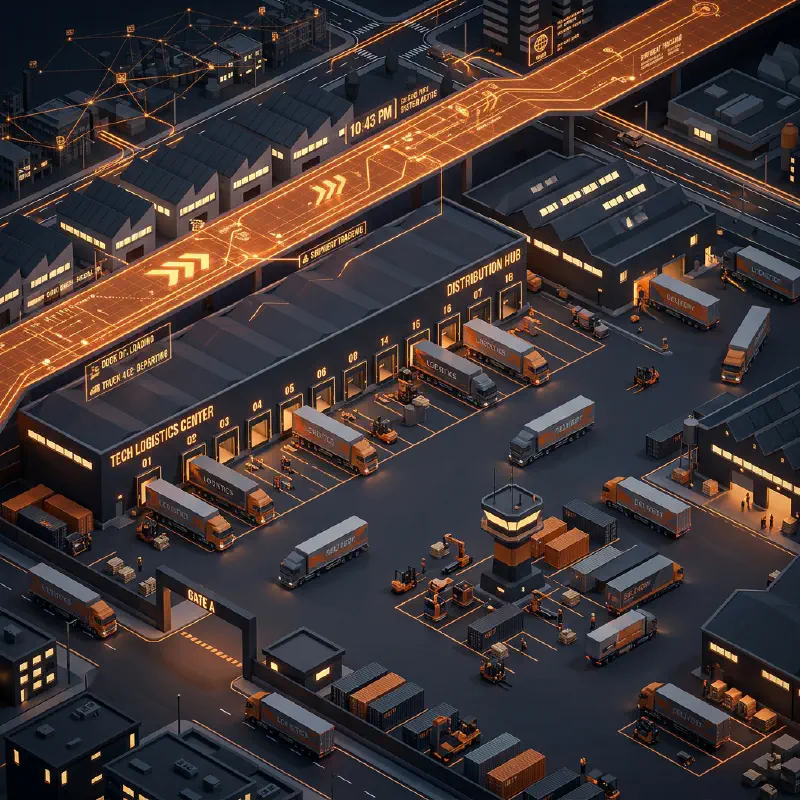
A YMS writes all of it down. A truck hits the gate, the system logs the arrival, checks it against the booking, and gives it a staging spot or a door based on what the load is and how full the yard is. The yard driver gets the task on a handheld rather than over the radio. Every move is time-stamped and located.
For whoever runs the yard, the point is simple. You stop guessing where trailers are. You stop paying carriers for time your own delay created. And your warehouse and transport systems finally get the yard data they were never built to capture.
What Is the Real Cost of Not Having a YMS?
Quick answer
None of these is hypothetical. They are line items, just not in the same place.
Detention and demurrage. The most visible one. Free time runs out quickly when a truck sits in a queue because nobody knows which door is about to open. Check the detention rate in your own carrier contracts, multiply by the hours you were billed for last quarter, and you have the figure. CSCMP’s annual State of Logistics report has identified detention as one of the fastest-growing cost categories in domestic freight.
Idle dock doors. A site without a YMS usually cannot say how much of its door capacity it actually uses, because nobody records when a door was free. Operations that do well on this manage the yard as an asset rather than as a car park, and a utilisation target is meaningless until you know your own starting point. The first step is measuring it: log when each door was occupied for a fortnight, by hand if you have to.
Safety. Unauthorised trailer moves, reversing into an occupied door, and people walking where vehicles are moving all become more likely when nobody knows what is where. Those incidents carry direct costs in compensation and indirect costs in downtime. Both belong in the business case, and both are usually left out.
Carrier goodwill. Drivers who wait a long time at your site talk, and so do their dispatchers. At your next tender, the bids will quietly include a premium for a difficult site. You will never see it itemised, and you will pay it.
How Does Yard Prediction Go Beyond Basic YMS Tracking?
Quick answer
A YMS is a record. That alone is a big step up from a whiteboard. The next step is turning that record into a short list of things to deal with.
Expected congestion. Past arrival patterns, carrier punctuality and the current state of the yard together say when the pressure will come. That is enough to move yard drivers and clear staging lanes before the queue forms rather than after.
Which trailer moves next. Better than first-in, first-out. Rank the waiting trailers by what is on them, what they are committed to deliver, how perishable it is, and how close the carrier is to the end of its free time. The ranking is a suggestion for a yard supervisor to confirm or overrule.
Things nobody noticed. A trailer that has not moved in days. A carrier whose arrivals are drifting later week by week. A door that consistently takes longer per load than the ones beside it. All three are in the data already, and none of them shows up on a screen full of current positions.
MIT’s Center for Transportation & Logistics researches modelling a site as a live digital copy of itself. That is the idea underneath this: treat the yard as something with a state and a history, not as a parking area with a gate.
How Do You Know If Your Facility Is Ready for a YMS?
Quick answer
A rough test: busy gate, more doors than one person can watch, and a recurring detention bill. If all three are true, a YMS will pay attention to something nobody currently owns.
The connection work is well trodden. A YMS reads your warehouse system for what is arriving and leaving, your transport system for booked appointments, and your gate equipment for check-in. Most warehouse and transport systems already offer the interfaces needed.
What separates a useful rollout from an expensive one is what you do with the data afterwards. Knowing where trailers are is the floor. Using the record — with carrier punctuality, your throughput pattern and who is actually on shift — to decide what moves next is where it starts paying.
Conclusion
Quick answer
The yard is the last mile of the first mile. Every shipment in or out goes through it, and it is the part nobody instruments.
A worthwhile first step, before any product decision: your average gate-to-gate time for last quarter, and the detention you paid against it. Most operations cannot produce either figure, which is itself the finding. Talk to us if it would help to work them out.
If your detention bill is rising, your doors sit idle at the wrong times, and your yard drivers navigate by memory, the question is not whether you need a YMS. It is how many more quarters of that you want to pay for first.
Sources
- Council of Supply Chain Management Professionals (CSCMP) — Annual State of Logistics Report, which identifies detention and demurrage as fast-growing freight cost categories
- OSHA Warehousing & Distribution Safety Standards — Federal guidance on powered industrial trucks, keeping people and vehicles apart, and yard safety