


What are the Key Takeaways from this Executive Summary?
Quick answer
- A supply chain digital twin is a live copy of physical assets and workflows, kept up to date from the data those assets report.
- They come in four sizes: a component, a piece of equipment, a site, and a whole process.
- Autonomous decisions are what vendors add on top: software that does not just warn you, but works out what to do about it.
- The hard part is not the reasoning. It is the approval line: which steps software may take on its own, and which ones a named person has to own because they carry legal or commercial liability.
1. Where Digital Twins Came From
For decades, supply chain managers have tracked goods through a mix of dashboards, overnight EDI messages and phone calls. Visibility was the bottleneck. As trade networks got more tangled and resilience became a board-level subject, simply seeing a delayed shipment stopped being enough. That gap is what digital twins are sold to fill.
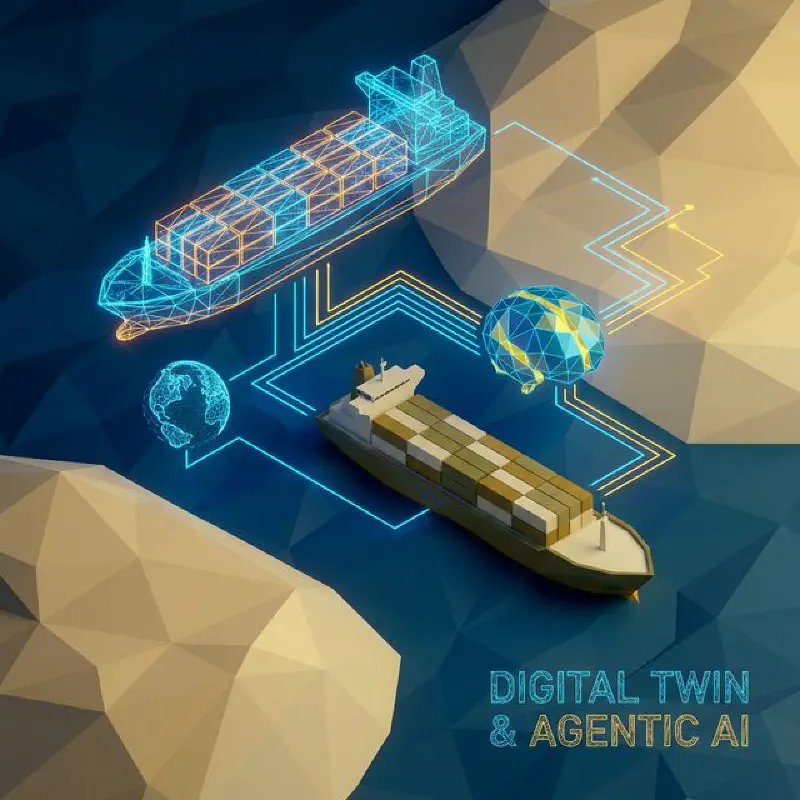
A digital twin is a copy of a physical thing — an asset, a site, a process — kept current from the data that thing produces. Unlike a static dashboard, a twin is updated in both directions: when the temperature inside a refrigerated container moves, or a queue builds at a cross-dock, the copy changes with it. That lets an operation test a scenario against the copy instead of against the real thing.
A precise copy of a supply chain is a serious piece of data work. It is also still a map. Knowing a critical part is stuck at the Port of Long Beach is useful, but it does not move the part. To get from watching to doing, the copy has to be paired with something that reads its state and proposes an action. That pairing is the subject of the rest of this piece, and it is where the honest differences between products lie. It also depends on the same groundwork as integrated logistics.
2. The Four Kinds of Digital Twin
Quick answer
Twins are not one thing. They differ in scope, and the scope decides what questions they can answer. Four kinds are generally recognised, and they nest inside each other. Each one needs the groundwork described in our data governance post.
Component twins
The smallest unit: one part of a larger asset. In logistics that might be a temperature sensor on a pharmaceutical shipment, or the motor in a robotic arm. These read high-frequency signals — vibration, heat, resistance — and look for the pattern that precedes a failure. The point is to replace a part before it stops the line, rather than after.
Asset twins
One whole piece of equipment, built from its components. A shipping container, or an automated vehicle on a warehouse floor. An asset twin cross-references many readings to describe how the asset is performing and how it is wearing. It answers questions an operator actually asks: is this container sound enough for another voyage? Is this vehicle using more power than it used to?
System twins
A set of assets working in one place: a warehouse, or a port. A system twin captures the interaction between stock, equipment, people and schedules. Given a rush of inbound cargo, it can test staging layouts against each other before the vehicles arrive, which is the only time that test is worth anything.
Process twins
The largest and the most useful: a whole end-to-end flow rather than a physical object. A process twin might cover the journey from raw material buying through customs to final delivery and returns. It takes in external conditions as well as internal records, so it can be asked what happens to stock in Europe if a factory in Southeast Asia shuts for a fortnight.
3. From Warning You to Proposing an Action
Quick answer
For years the standard was predictive: software that warns an operator of a problem coming. Useful, but the response still depends on a person working out what to do, across several systems. The newer category claims to close that gap.
The difference is that a predictive system is passive and analytical, while this one is meant to be active and prescriptive. Described in full, the sequence looks like this. It is the category’s own account of itself, not a description of any one product:
- Read the state. Take the current state from the twin.
- Fetch the context. Search the company’s own records for the relevant procedure, contract and precedent.
- Join the two. Work out what the state means for this business, given those records.
- Generate options. Produce several possible responses — air-freight part of the order, switch to a backup supplier, reallocate domestic stock.
- Test them. Run each option against the twin and score it on cost, emissions and service commitments.
- Choose one. Pick the best-scoring option under the company’s own rules.
- Write it down as steps. Turn the choice into the specific system changes it would require.
- Check it. Verify the proposed changes against the limits it is allowed to operate inside.
- Act. Make the changes: update the order system, book the alternative carrier, revise the promised date.
- Tell people. Notify the account manager and the customer, with the reason.
- Record the outcome. Keep the result so the next decision can be compared with it.
Steps one to eight are reading and reasoning. Step nine is different in kind, and the next section is about why.
4. Where the Approval Line Belongs
Quick answer
This is the design question Runink FACE answers in one specific way. FACE reads the records an operation already holds, works out what the combined picture means, and drafts the action — the short-pay, the claim rebuttal, the reallocation, the compliance note. The draft then waits in a queue for a named person to approve, edit or reject, and the decision is recorded against that person.
That is a narrower claim than the category usually makes, and it is narrow on purpose. In claims, customs and payment, the act carries liability, and liability does not transfer to software.
What the drafting step buys is the reading. Working out the three separate jobs a bill of lading is doing at once, or checking import documents against the rules that govern them for compliance, is work that defeats inspection by volume. Reading every record instead of a sample is where the change in outcome comes from — not from removing the approver.
Conclusion
If the bill of lading is the one document that does three jobs at once — receipt, contract and title — then a digital twin with a decision engine attached is the modern equivalent: one thing standing in for several. It gives an operation the picture, the reasoning over the picture, and a proposed response.
What it does not settle is who decides. That question does not go away with better software, and the operations that get the most out of this category are the ones that answer it first: which steps run unattended, which wait for a name, and how you would show the difference to an auditor.
For what Runink FACE reads, what it drafts, and where it stops: Runink FACE. To talk it through against your own records, get in touch.
Sources
- Council of Supply Chain Management Professionals (CSCMP) — Industry glossary and definitions for the logistics terms used above