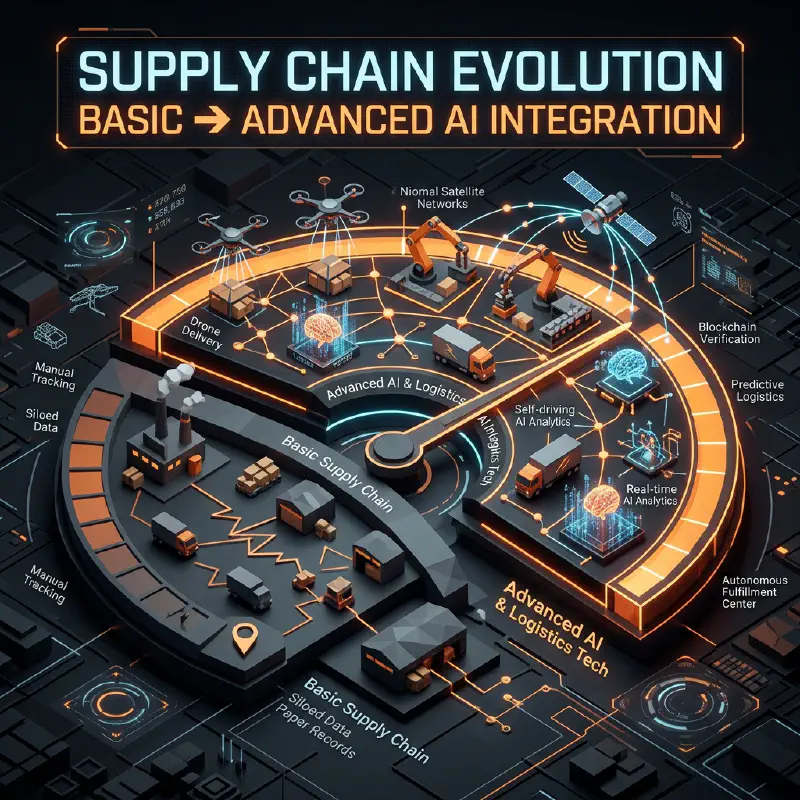
What are the Key Takeaways from this Executive Summary?
Quick answer
- Digitize, connect, analyze, automate. Each phase needs the one before it. You cannot read data you have not joined up, and you cannot join up records that are still on paper.
- People and process decide the outcome, not the product choice. A high shortfall rate for digital programmes is widely quoted; the part worth acting on is that the causes are mostly human.
- Pick the measure before the phase starts. Name the figure, say where in your own systems it lives, and record it before you change anything. A phase with no baseline cannot be shown to have worked.
Why Do Most Supply Chain Digital Transformations Stall?
Quick answer
Every supply chain and IT leader has heard the pitch: buy AI, save millions, run a supply chain that drives itself.
The floor tells a different story. Buyers are still matching purchase orders in Excel. A site manager checks three systems to confirm one stock count. A transport planner phones a carrier for an arrival time that a system should already hold.
That gap between the boardroom slide and the warehouse floor is where these programmes die. Far more of this work stalls at the pilot than is ever scaled past it, which is the pattern to plan against.
The cause is not a shortage of products to buy. It is the absence of an order of work, where each step is small enough to finish and each one can be shown to have worked.
What Are the 4 Phases of a Supply Chain Digital Transformation Roadmap?
Quick answer
Phase 1: Digitize — Eliminate the Paper Trail
The unglamorous phase, and the one that cannot be skipped. Paper bills of lading, manual freight invoices, spreadsheet demand plans and exceptions managed by email all become structured records in a system.
Until a record lives in a system rather than on a shared drive, nothing downstream can read it.
Operational markers: Digital purchase orders. Electronic bills of lading. Freight invoices checked and paid by system rather than by hand. Stock counts in the warehouse system instead of on a clipboard.
What to measure: Start with freight invoices. Count how many you paid last quarter, how many were checked against the contracted rate, and how many duplicates you found. Those three numbers are usually available the same week you ask for them, and they tell you what checking by system is worth to you.
Phase 2: Connect — Make the Systems Share One Record
Digital records stuck in separate systems are only slightly better than spreadsheets. This phase is about joining them: your ERP, transport system, warehouse system, yard system and carrier feeds all reading the same order.
This is where old EDI messages get modernised, carrier links move to interfaces that answer on request, and somebody finally owns the master data.
Operational markers: One order record travels from buying, through the warehouse, to final delivery without being re-typed. Stock is visible across sites, in transit, and at third-party warehouses. Carrier performance data reaches the buying team without a manual export.
What to budget: This phase is routinely underestimated, because the work is unglamorous and the problems only appear when two systems disagree. Before you plan it, count how many times one order gets re-typed today between first entry and final delivery. Each re-typing is a place where the two systems will disagree, and each one has to be fixed here rather than later.
Phase 3: Analyze — See the Supply Chain, Not Just Report on It
With connected records, you can move from reports about last month to a view of this morning. This is where dashboards, demand sensing, on-time-in-full scorecards with causes attached, and network reviews belong.
The goal is not more reports. It is fewer things that need a meeting.
Operational markers: A freight status view replaces the daily status call. Alerts name the specific load that is sitting too long, the container heading for demurrage, or the carrier whose on-time rate is slipping. Fill rate analysis points at a lane, a carrier or a site rather than at the month.
The inflection point. Teams that reach this phase with clean, joined-up records can move on quickly. Teams that arrive here with the first two phases half-done spend their time arguing about whose number is right.
Phase 4: Automate — From Dashboards to Decisions
This is where software starts doing the routine deciding: picking the carrier on today’s cost, capacity and service; adjusting safety stock as demand moves; deciding which inbound load crosses the dock instead of going into racking.
Operational markers: Planners move from making each decision to setting the rules and checking the exceptions. Software handles the high-volume, rules-based calls — full truckload against less-than-truckload, when to reorder, which loads to combine. People handle the judgement calls and the carrier relationships.
What this does not require: You do not have to replace your transport or warehouse system. What you need is something that reads them, compares what it finds against your rules, and puts a drafted decision in front of the person who can approve it.
Why Is Change Management the Real Risk — Not Technology?
Quick answer
Digital programmes fall short more often than not — you will have seen the percentages, and we are not going to add another one we cannot source. The pattern behind them is consistent and is the useful part: the causes are mostly human rather than technical.
Three things tend to separate the programmes that hold from the ones that fade. Visible sponsorship, so the work does not get traded away at the first budget review. Training that makes the new way genuinely easier than the old way, not merely mandatory. And an early, small result people can see — not a forecast of one.
Skip any of the three and the spreadsheets will outlast the programme.
How Should Leaders Measure Digital Transformation Progress?
Quick answer
Avoid measuring a programme by how much of it has been installed. Logins, dashboard views and integration milestones tell you what you built, not what changed. Boards do not fund cleaner data.
How to set each measure up:
- On-time delivery. Take it from your transport system, by lane and by carrier, for the last four full quarters. Late handovers between systems are the part this work should move, so split out the failures caused by information arriving late.
- Total logistics cost. Take freight, warehousing and accessorial charges from the finance ledger as a share of revenue, over the same four quarters. Name which charge codes are in and which are out, and keep that definition fixed.
- Stock held. Take safety stock by line from the warehouse system, and the reason each buffer was set at that level. Buffers set to cover information gaps are the ones this work can move. Buffers set to cover supplier lead time are not.
- Order to delivery time. Measure from order entry to delivery confirmation, and record how much of that is waiting for an approval rather than waiting for a truck.
Re-read the same four measures each quarter, from the same sources. Each phase should earn the next.
Conclusion
Quick answer
The route from spreadsheets to automated decisions is real. It needs operational discipline more than it needs procurement.
The hardest step is the last one: moving from seeing the problem to acting on it. Most teams stall there, not because the software does not exist, but because acting on a record means trusting it, and trust has to be earned phase by phase.
Runink FACE is built for that step. It reads the records an operation already holds, compares what it finds against the rules that govern it, and puts one drafted action in front of the person who can approve it. It replaces none of the systems underneath, and it acts on nothing without that approval.
If your programme has stalled at dashboards, the first thing to establish is not which product to buy. It is how long your operation takes today to go from something being recorded to somebody acting on it. Few operations have ever counted it, and it is usually where the cost sits. Talk to us if it would help to work it out.
Sources
- McKinsey & Company — Digital Supply Chain Transformation — Background reading on why digital supply chain work stalls after the pilot
- World Economic Forum — Supply Chain Transformation — Global perspectives on supply chain resilience and the case for digitising records
- BCG — Supply Chain Digitization Research — Background reading on change management as the constraint on adoption