


What are the Key Takeaways from this Executive Summary?
Quick answer
- Data quality: ISO 8000 defines what accurate, complete, consistent and timely data means, and how to exchange master data between organizations.
- Security and cloud: the ISO 27000 family covers information security management; ISO 27017 and ISO 27018 cover cloud services and personal data held in them.
- Models and privacy: ISO 42001 sets management requirements for artificial intelligence. ISO 27701 extends a security management system to cover privacy, so the two are audited together rather than twice.
Most companies now run on data. Forecasts, pricing, customer contact and product decisions all draw on it. Data is only worth what its accuracy, its security and its provenance are worth. One breach, one privacy complaint or one bad dataset and the work stops while people argue about whether the numbers can be trusted.
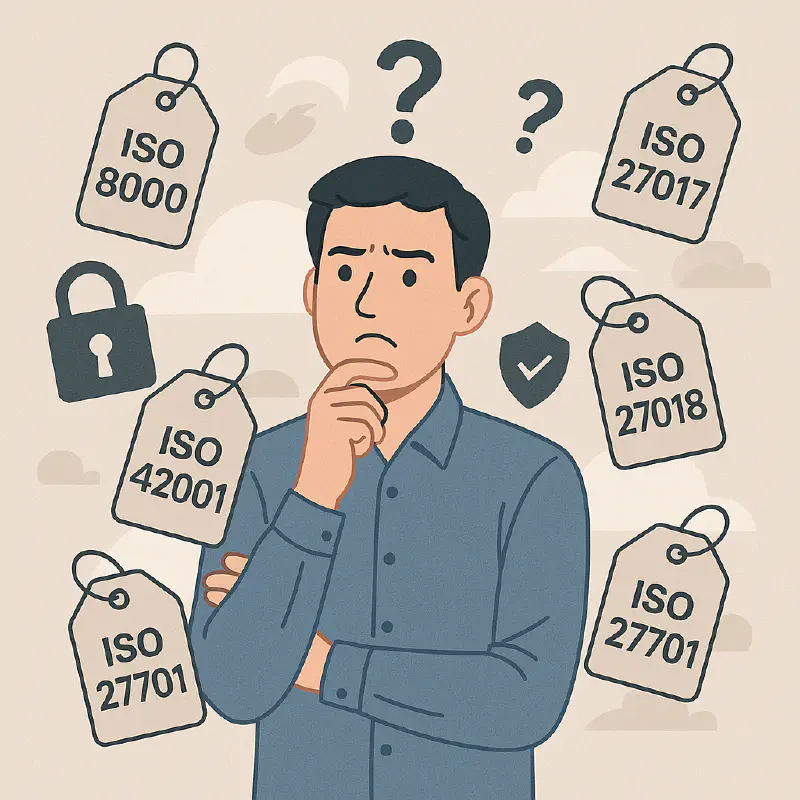
Six internationally recognized standards divide that problem into parts: ISO 8000, ISO 27000, ISO 27017, ISO 27018, ISO 42001 and ISO 27701. This post says what each one asks of you, and how they fit together.
How Does 1. ISO 8000: Elevating Data Quality for Accurate Insights Impact Your Strategy?
Quick answer
ISO 8000 sets requirements for data quality management and master data exchange. It defines what good data means: accurate, complete, consistent and timely. For a data-driven business, that has three practical effects.
- Fewer errors to chase in analytics. Clean data feeds models and dashboards without skewing the result, and nobody spends the first hour of a meeting disputing the figure.
- Less rework. Manual cleansing is work that produces nothing new. Every hour of it is an hour the same records were wrong somewhere upstream.
- Evidence for reporting. Records that carry their own origin and history can be reported and audited without a reconstruction exercise.
The point of writing ISO 8000 into data governance is that every downstream process — model training, customer segmentation, a quarterly board pack — starts from records that have already been checked once, in one place.
How Does 2. ISO 27000: The Backbone of Information Security Management Impact Your Strategy?
Quick answer
The ISO/IEC 27000 family covers Information Security Management Systems (ISMS). At its center is ISO 27001, which sets out how to identify security risks, assess them and decide what to do about each one — across people, process and technology, not only technology. What that gives you:
- One security posture instead of several. Physical, technical and administrative controls sit in the same register, with the same owners and review dates.
- A review schedule. Audits happen on a cycle, so controls get revisited as threats change rather than when someone remembers.
- Something to show. Certification gives customers, partners and regulators a third party’s word rather than yours.
Aligned with ISO 8000, ISO 27000 covers the other half of the same question: ISO 8000 asks whether the data is right, ISO 27000 asks who can reach it.
How Does 3. ISO 27017: Cloud‑Specific Security Controls Impact Your Strategy?
Quick answer
As companies move work to public, private and hybrid clouds, ISO/IEC 27017 adds cloud-specific guidance on top of ISO 27001. Its most useful part is the split of duties between the cloud provider and the customer, written down rather than assumed. It covers:
- Machine configuration. Servers are built secure from the start, not hardened later.
- Keeping customers apart. One customer’s environment is separated from the next, so a problem in one does not travel.
- Erasing data. What happens to the data when a contract ends or a machine is retired, and who confirms it is gone.
Written into a contract, ISO 27017 gives you the same security expectations with every provider you use, and the same questions to ask the next one.
How Does 4. ISO 27018: Protecting Personal Data in the Cloud Impact Your Strategy?
Quick answer
Where ISO 27017 covers cloud security, ISO/IEC 27018 covers personal data — what most privacy law calls personally identifiable information (PII). It asks for:
- Documented consent. The provider obtains and records consent for what it does with the data.
- Transparency. The customer is told where the data sits and who can reach it.
- Breach notification. Alerts arrive in time to act on, and say enough to act on.
- Individual rights. There is a working route for a person to see their data, correct it or have it deleted.
Used as the basis for a cloud contract, ISO 27018 turns a privacy obligation under GDPR or CCPA into a list of things a provider either does or does not do.
How Does 5. ISO 42001: Responsible Model Governance Impact Your Strategy?
Quick answer
A model that decides things can be wrong at scale. ISO/IEC 42001 is the management system standard for artificial intelligence, and it covers:
- Accountability. A named owner for each model, and a written account of what it is allowed to decide on its own.
- Risk. Testing for bias, for drift as the world moves away from the training data, and for outcomes nobody intended.
- Training data. Where it came from, what it contains, and whether you are allowed to use it.
- Monitoring. Checking performance after release, not only before it.
With ISO 8000 on the data and ISO 27000 on the access, ISO 42001 covers the third question: who decided this, and on what basis.
How Does 6. ISO 27701: Privacy Information Management Impact Your Strategy?
Quick answer
ISO/IEC 27701 extends ISO 27001 with a Privacy Information Management System (PIMS) — privacy managed inside the security system rather than beside it. It covers:
- Privacy risk assessment. What a given use of data does to the people it describes.
- Day-to-day controls. One way of handling data subject access requests (a DSAR: a person asking what you hold on them), consent records and breach response.
- Mapping to law. The same controls answer GDPR, LGPD and comparable regimes, instead of one set per jurisdiction.
Built onto an existing ISMS, ISO 27701 means one control register, one audit, one set of owners.
How Does 7. Reading the Six Standards Together Impact Your Strategy?
Quick answer
On its own, each standard answers one question. Read together, they cover the ground without overlapping:
| Standard | Primary Focus | What it gives you |
|---|---|---|
| ISO 8000 | Data quality | An agreed definition of accurate, complete, consistent and timely |
| ISO 27000 | Information security | One risk register across people, process and technology |
| ISO 27017 | Cloud security | The split of duties between you and your provider, in writing |
| ISO 27018 | Cloud privacy | Contract terms for personal data held by a provider |
| ISO 42001 | Artificial intelligence | Named accountability for what a model decides |
| ISO 27701 | Privacy management | Privacy and security audited as one system |
Adopted together, they produce one control register rather than six, which is mostly a saving in argument: fewer duplicate controls, fewer owners per control, one evidence set at audit.
How Does 8. Practical Implementation Steps Impact Your Strategy?
Quick answer
- Gap analysis
- Compare what you do now against what each standard asks for.
- An executive owner
- One person with the budget and the authority to move people onto this work.
- Policies
- Write down the rules for data quality, security, privacy and model use.
- Tools
- Pick what you need to do the job: a data catalogue, log collection and alerting, data loss prevention, model monitoring.
- Training
- Teach the staff, partners and suppliers who will live with the new controls.
- Internal audit
- Check yourself before an external auditor does.
- Fix and repeat
- Use the audit findings to change the process, then audit again.
How Does 9. Business Benefits of a Unified ISO Framework Impact Your Strategy?
Quick answer
- Decisions on data you can defend. Models and dashboards are fed by records whose quality is defined and measured, so a disputed number has a source to check.
- Compliance done once. One integrated set of controls answers GDPR, CCPA, HIPAA and their equivalents, rather than one project per regulation.
- A straight answer for customers. A security questionnaire is answered from the control register, in days rather than weeks.
- Less duplicate work. Count the controls in your own registers that exist twice under two names. That count, before and after, is the measure of what integration is worth to you.
- Fewer surprises. Monitoring, audits and reviews on a schedule mean the bad news arrives early and internally.
How Does 10. Avoiding Common Pitfalls Impact Your Strategy?
Quick answer
- One standard at a time, in separate silos
- Adopt them together and you write each shared control once. Adopt them separately and you write it six times, with six owners.
- Treating it as an IT project
- The controls bind Finance, Operations and Sales as much as IT. If only IT hears about it, only IT follows it.
- Stopping at your own perimeter
- Suppliers, partners and cloud providers handle your data. The controls have to reach them, through contracts.
- Leaving the evidence to the end
- A control with no evidence behind it fails the audit even when the control works. Collect it as you go.
How Does 11. Conclusion: A Blueprint for Data‑Driven Excellence Impact Your Strategy?
Quick answer
Data now sits behind most of what a company decides, so the question customers and regulators ask is not whether you hold data but whether you can account for it. ISO 8000 for data quality, ISO 27000 for security, ISO 27017 and ISO 27018 for cloud, ISO 42001 for artificial intelligence, and ISO 27701 for privacy are six ways of being able to answer.
Taken together, they amount to a plain claim you can make and support: you know where your data came from, who can reach it, what decides things with it, and what happens when somebody asks you to delete it.