What Is a Digital Twin? How Agentic Decisions Are Reshaping the Supply Chain
1. The Emergence of the Supply Chain Digital Twin
In the intricate, globally distributed machinery of international trade and logistics, visibility has historically been the primary operational bottleneck. For decades, supply chain managers have relied on fragmented dashboards, delayed Electronic Data Interchange (EDI) messages, and manual updates to track the movement of goods. However, as global trade networks grow exponentially more complex and resilient logistics become a board-level imperative, merely seeing a delayed shipment or a low inventory alert is no longer sufficient. Enter the Digital Twin—a concept that is fundamentally altering how organizations interact with physical reality.
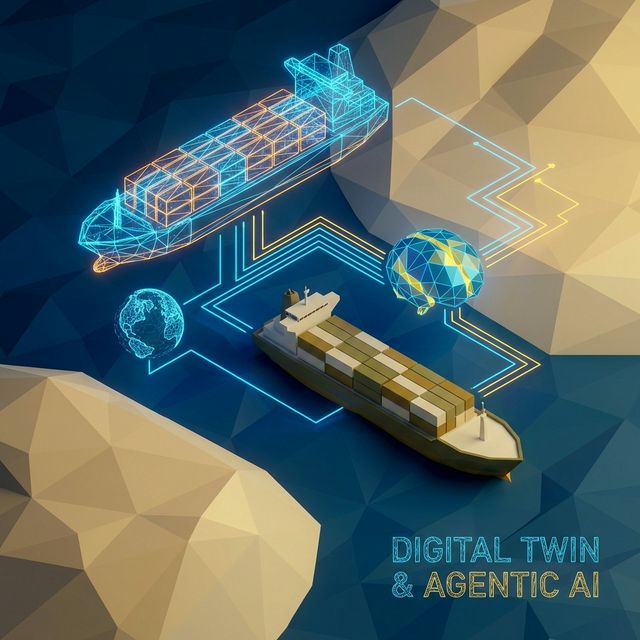
At its core, a Digital Twin is a dynamic, highly granular virtual replica of physical assets, processes, systems, or environments. Unlike traditional predictive models or static digital dashboards, a true Digital Twin maintains a continuous, bidirectional flow of telemetry data with its physical counterpart. When the physical state changes—whether it’s the temperature fluctuation inside a refrigerated ocean container or a bottleneck forming at a critical cross-docking facility—the digital state updates instantaneously. This real-time synchronization allows organizations to simulate scenarios, predict system failures before they occur, and optimize their operations with mathematical precision.
However, while creating a precise digital map of a supply chain is a monumental achievement in data integration, a Digital Twin is ultimately just a map. Knowing that a critical component is delayed at the Port of Long Beach is valuable, but it does not inherently solve the problem. To transition from mere observability to active orchestration, this virtual replica must be paired with Agentic Decisions—specialized Artificial Intelligence systems capable of interacting with the twin, interpreting its state, and executing autonomous actions across the enterprise stack. Together, these technologies do more than just monitor global trade; they form the foundation of next-generation integrated logistics.
2. The Four Archetypes: Understanding Types of Digital Twins
Digital Twins are not monolithic; they scale in complexity, scope, and computational demand depending on the physical reality they are designed to model. In the context of supply chain data architecture, they are generally categorized into four distinct, hierarchical archetypes. Understanding these types is critical for establishing a robust Data Governance Strategy.
Component Twins (The Foundational Tier)
At the most granular level, Component Twins model an individual, critical part of a larger asset. In logistics, this might be a specific IoT temperature sensor on a pharmaceutical shipment or a single robotic arm’s motor within an automated fulfillment center. These twins analyze high-frequency, low-latency telemetry data (such as vibration, heat, or electrical resistance) to predict imminent mechanical failure. By applying anomaly detection algorithms to this stream, operators can replace a failing component before it causes a catastrophic shutdown, effectively turning reactive maintenance into preventative care.
Asset Twins (The Product Tier)
Asset Twins scale up to encompass an entire piece of equipment by aggregating the data from its underlying components. A prime example is the digital replica of an ocean freight container or an autonomous guided vehicle (AGV) traversing a warehouse floor. An Asset Twin doesn’t just look at a single sensor; it cross-references thousands of data points to model the performance and degradation of the entire asset over its operational lifecycle. It answers operational questions like: Is this container structurally sound for another voyage? Is this AGV operating at peak energy efficiency?
System Twins (The Network Tier)
Scaling further outward, System Twins model how different assets interact within a constrained, complex environment. A digital twin of an entire warehouse or a major seaport is a System Twin. It captures the intricate dance between inventory management systems, forklift fleets, human operators, and scheduling algorithms. If a System Twin detects a sudden influx of incoming cargo, it can simulate thousands of spatial routing configurations to determine the optimal staging layout, preventing gridlock before the physical trucks ever arrive at the loading docks.
Process Twins (The Macro Tier)
The most valuable and complex archetype is the Process Twin. Rather than modeling physical objects, Process Twins model sweeping, end-to-end operational workflows. In supply chain logistics, a Process Twin might simulate the entire journey of a product, from raw material procurement and supplier negotiations, through international customs, down to final-mile fulfillment and even returns management. Process Twins ingest macroeconomic indicators, weather patterns, geopolitical risks, and historical ERP data to optimize the entire value chain. They simulate what will happen to inventory levels in Europe if a factory in Southeast Asia shuts down for two weeks, allowing executives to pivot sourcing strategies proactively.
3. Agentic Decisions: The Shift from Predictive to Autonomous
For years, the gold standard of supply chain technology has been predictive analytics—systems that warn human operators of impending issues. While valuable, this paradigm still relies on human intervention to formulate a response, navigate disparate software systems, and execute the fix. Agentic Decisions shatter this limitation by introducing AI systems that do not merely predict, but actively resolve.
Traditional AI is primarily analytical and passive. Agentic AI, driven by Cognitive Robotic Process Automation (Cognitive RPA), is active and prescriptive. It operates as a digital employee interacting with the Digital Twin.
The 11-Step Agentic Fetch Pipeline
At the forefront of this revolution is a sophisticated architecture designed to ensure safe, deterministic, and scalable autonomous execution. When a Process Twin flags a supply chain anomaly—for instance, a severe weather event delaying a container ship carrying critical Q4 inventory—the Agentic decision engine engages an 11-step pipeline designed to mitigate the crisis:
- State Ingestion: The agent consumes real-time state changes from the Digital Twin.
- Context Retrieval: Utilizing Retrieval-Augmented Generation (RAG), the agent searches corporate vector databases for relevant standard operating procedures, vendor contracts, and historical precedents.
- Semantic Grounding: The raw data is combined with corporate knowledge to form a complete understanding of the business impact of the delay.
- Hypothesis Generation: The agent leverages advanced Language Models (like Gemma 3) to generate multiple potential mitigation strategies (e.g., air-freighting a subset of inventory, sourcing from a backup supplier, or reallocating existing domestic stock).
- Simulated Validation: The 11-step pipeline feeds these hypotheses back into the Digital Twin to run Monte Carlo simulations, scoring each option against financial ROI, carbon emissions, and customer SLAs.
- Decision Selection: The agent selects the mathematically optimal path based on predefined corporate governance rules.
- Action Formulation: The agent translates the decision into a sequence of API calls and system commands.
- Strict Mode Verification: Before execution, the payload is checked against “Strict Mode” infrastructure standards to prevent unauthorized financial or data exposure.
- Execution: The agent autonomously executes the actions—updating the ERP, engaging alternative logistics providers via API, and updating estimated delivery dates in the CRM.
- Stakeholder Communication: The agent drafts and dispatches contextual notifications to account managers and end customers, explaining the delay and the proactive resolution.
- Feedback Loop: The outcomes are recorded back into the Snowflake data warehouse to train future iterations of the model.
This is the power of Agentic Decisions: transforming a complex, potentially disastrous supply chain disruption into an autonomously managed, invisible background process.
4. The Runink Ecosystem: Architecting the Future of Global Trade
At Runink, we recognized early on that the true value of a Digital Twin is only unlocked when paired with a secure, highly capable autonomous agent. We are building the critical infrastructure required to bridge comprehensive Digital Twins with enterprise-grade autonomous action. The Runink Analytics Companion is designed to serve as the intelligent “brain” interacting with your supply chain’s virtual replica.
Powered by advanced Cognitive RPA, our Companion goes far beyond basic data aggregation. It is engineered with deep specialization in logistics operations, allowing it to seamlessly navigate the nuances of global trade. Whether it is parsing the complex legalities and “Tripartite Personality” of a Bill of Lading or continuously auditing import documentation to ensure flawless Compliance, the Runink Companion leverages agentic decisions to act as an untiring, continuously learning member of your supply chain team.
Visualizing the Agentic Digital Twin Ecosystem
To fully grasp how these components converge to automate complex logistics operations, consider the following C4 Context workflow depicting the interaction between the physical world, the Digital Twin, and the Runink Agentic Engine:
Conclusion: The Swiss Army Knife of Tomorrow
If the Bill of Lading has historically served as the “Swiss Army Knife” of global trade—a single document simultaneously acting as a receipt, a contract, and a title—then the combination of Digital Twins and Agentic Decisions represents its modern, digital equivalent. Together, they provide the visibility, the processing power, and the autonomous execution required to navigate an increasingly volatile world.
By adopting these advanced technologies, supply chain leaders can finally transcend the era of reactive firefighting. They can embrace a new paradigm of proactive, autonomous optimization, ensuring their supply chains remain resilient, efficient, and infinitely scalable in the face of tomorrow’s challenges.
Ready to transition from passive visibility to autonomous optimization? Discover how the Runink Analytics Companion can transform your operations today.