What are the Key Takeaways from this Executive Summary?
Quick answer
- What it removes: put-away, storage and retrieval. The pallet never goes on a rack, so nothing is paid to hold it and nothing is spent picking it back out.
- Three models, different prerequisites: pre-distributed, post-distributed and opportunistic. Which one fits depends on how disciplined your suppliers are and how variable your orders are.
- It is unforgiving: with no storage buffer, a late trailer is a missed outbound load rather than an inconvenience. The scheduling has to be right before the model can pay.
What Is Cross-Docking and Why Does It Matter for Distribution Operations?
Quick answer
Every pallet on a rack costs money: the space, the capital tied up in the stock, the labour to put it away and fetch it again, and the risk of damage or obsolescence while it waits. For a distribution centre manager under pressure on fill rates and delivery windows, cross-docking is a different way of arranging the same flow.
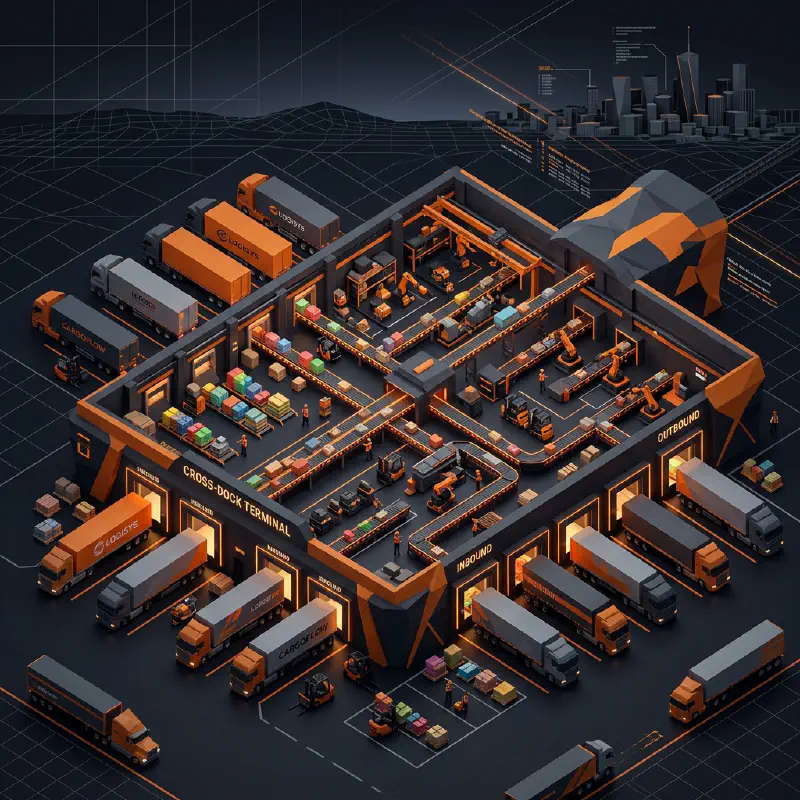
The idea is plain. Goods arrive at an inbound door, are sorted or re-palletised on the floor, and go out of an outbound door — usually the same day, often within hours. No shelving, no racking, no picking from reserve. The building works as a place freight passes through rather than a place it waits.
This is not new. Walmart built cross-docking into its distribution network in the 1980s, and it remains central to how that network runs. What has changed is the coordination. Dock scheduling and carrier coordination no longer have to happen by phone, which is what made the model hard to run outside the largest operations.
What Are the Different Types of Cross-Docking?
Quick answer
Work out which model fits before redesigning a building or buying software for it.
Pre-distributed cross-docking is the simpler one. Suppliers or upstream sites pack and label for the final destination before the freight arrives. Inbound pallets are already sorted: they come in one door and go out the right one. It needs suppliers who comply, advance shipping notices (ASNs) you can rely on, and demand that does not swing much. Grocery replenishment and retail store distribution are the classic cases.
Post-distributed cross-docking is harder and more flexible. Goods arrive in bulk and are sorted, broken down and allocated at the facility against current orders. It needs current inventory data, fast sortation and a warehouse system that can allocate on the fly. It suits operations where orders vary day to day, such as e-commerce fulfilment or pharmaceutical distribution.
Opportunistic cross-docking is the hybrid, and it is growing. The warehouse or transport system spots inbound shipments that match open outbound orders and routes just those straight through, while everything else is put away as normal. It lets an operation take some of the benefit without committing the whole network to the model.
Which Industries Benefit Most from Cross-Docking?
Quick answer
Grocery and fresh goods are the original case. When shelf life is days, time in a building is not just cost; it is spoilage and a food safety question. Cross-docking keeps the cold chain shorter by keeping the product moving.
Pharmaceutical and healthcare distribution benefits from speed and from traceability. Temperature-sensitive biologics, controlled substances with strict chain-of-custody rules, and hospital replenishment all need throughput. Serialisation and track-and-trace obligations are easier to satisfy when product passes through a site in hours rather than days.
Fast fashion and seasonal retail face a different clock: stock that loses value while it sits. Cross-docking shortens the gap between production and the shop floor, which is the difference between full price and markdown. Zara built its distribution model around flow-through for that reason.
E-commerce and direct-to-consumer is the newer case. Cross-docking at regional sortation sites supports next-day delivery without having to hold stock forward in dozens of local warehouses.
What Are the Operational Prerequisites for Successful Cross-Docking?
Quick answer
Cross-docking is unforgiving. When freight has to cross a building in hours, there is no slack for a scheduling error or a missing ASN. These are the non-negotiables.
Dock scheduling precision. Inbound and outbound trailers have to be paired to the hour. A yard management system (YMS) that holds door assignments, trailer positions and appointments is how that is done at any scale. Without it you get congestion, demurrage — the charge for holding equipment past its free time — and the dwell time you set out to remove.
Knowing what is coming. You need to know what is arriving, when, and in what configuration, before the trailer reaches the gate. That means ASNs suppliers actually send, arrival estimates on inbound carriers, and an alert on a late shipment early enough to change the outbound plan. Blind receiving and cross-docking do not mix.
Carrier discipline. Outbound carriers must be there when sortation finishes. A late pickup congests the floor, and the congestion spreads to the next wave. Carrier scorecards, booked appointments and agreed consequences for no-shows are the ordinary tools.
Sortation speed and labour planning. Unloading, sorting, re-palletising and loading have to be staffed for the hour they happen in, not the shift. Conveyors, scan-and-sort and flexible staffing are what separate a two-hour dock-to-dock cycle from a six-hour one.
What Does Software Actually Add to a Cross-Dock?
Quick answer
A traditional cross-dock runs on a static schedule plus manual recovery when the schedule breaks. Three capabilities are what this category of software is actually selling, and they are worth separating from each other.
Better arrival estimates. Using past carrier performance, traffic and weather to estimate when a trailer will really arrive, rather than when it was booked. The useful output is a revised time plus a flag on the outbound appointments that no longer line up with it.
Matching loads. Comparing inbound ASN data against open outbound orders to find the cross-dock opportunities a fixed plan misses. This is the mechanism behind opportunistic cross-docking at volume: surfacing candidate matches across thousands of items and hundreds of orders that no planner would find by hand.
Working out knock-on effects. Spotting a disruption — a carrier no-show, a short shipment, a quality hold — and working out what it breaks downstream before it breaks it. Whether the resulting reroute, door reassignment and notification go out on their own or wait for a supervisor’s approval is the single most consequential question to ask a vendor in this category, because the answer determines who carries the consequences of a wrong call.
Runink FACE answers it one way: the reading and the comparison run unattended, and the proposed action goes to a named person to approve, edit or reject. Connect with our team to walk through what that looks like against your own dock schedule.
Conclusion
Quick answer
The economics are not subtle: an hour a pallet spends in storage is an hour that earns nothing. Cross-docking — pre-distributed, post-distributed or opportunistic — takes that out of the flow. But the bar is high. Without paired dock schedules, current shipment information and carriers who keep appointments, cross-docking adds more risk than it removes.
Before evaluating tools for it, establish two figures for your own operation: average dock-to-dock handover time, and the proportion of inbound loads whose actual arrival fell outside the appointment window last quarter. Neither is hard to extract, both are usually unknown, and together they tell you whether cross-docking is a scheduling problem or a carrier problem in your network. The Runink FACE use cases describe how records of that kind are read and compared.
Sources
- Council of Supply Chain Management Professionals (CSCMP) — Industry glossary and definitions for cross-docking and distribution centre terms
- Georgia Tech Supply Chain & Logistics Institute — Research on warehouse design, facility layout and material flow
- Warehousing Education and Research Council (WERC) — Benchmarking studies on distribution centre productivity and dock-to-stock cycle times